



Financial infrastructure for global game operations
Manage global payouts, multi-currency revenue, team spending and operational finance from one platform.



Why game studios choose Altery
Gaming companies operate across international teams, contractors, publishers, storefronts and production partners. Altery helps game studios manage payouts, currencies, cards and financial operations from one centralised platform.
 USD
USD

 EUR
EUR
 GBP
GBP







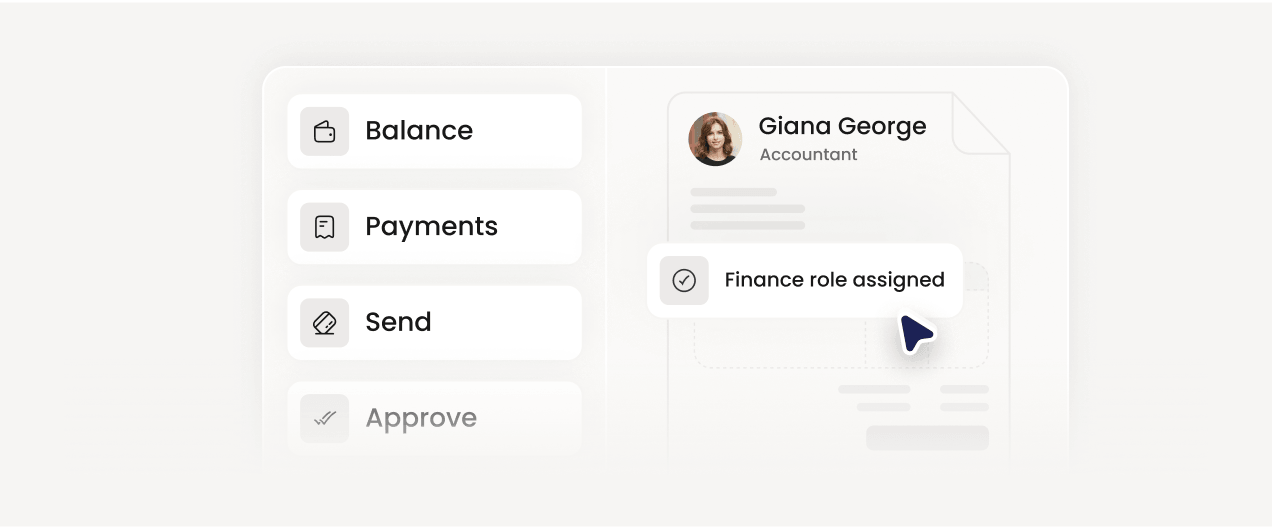
Role-based access for growing teams
Give teams controlled access with permissions tailored to each role and entity. Set spending limits, approve payments faster and track transactions in real time, all from one place.
 Lucas Whitmore
-1,300.00 GBP
Lucas Whitmore
-1,300.00 GBP
 Oliver Bennett
-3,500.00 EUR
Oliver Bennett
-3,500.00 EUR

Mass payouts for distributed teams
Pay contractors, artists, QA teams, localisation partners and external vendors across multiple countries from one platform.


Multi-currency accounts for global revenue
Receive and manage payments in multiple currencies while keeping better visibility over international revenue and operational spending.

Cards for production and operational spend
Issue virtual and physical cards for subscriptions, advertising, software tools, travel, and day-to-day operational expenses.
One platform for gaming finance operations
Manage payouts, balances, cards, approvals and financial workflows from one place instead of relying on fragmented banking tools.
Run gaming finance from one account
Support global production, simplify payouts and manage operational spending with infrastructure designed for modern gaming businesses.
Open your accountGame studio finance guides
Practical answers to the money questions game studios run into, from getting paid by storefronts to paying a global team.

Ring-fencing user-acquisition ad spend from operating cash
User-acquisition budgets scale up fast and bill across several ad networks at once. Here is how to ring-fence UA spend from your operating cash and keep per-platform control.
 Zara Chechi

Managing cash runway between game launches
Studio income arrives in launch-shaped lumps, not a steady line. Here is how to manage the spike, the declining tail and the dry spells between titles so you can fund the next game.
Zara Chechi

One account per game IP: separating revenue by title
Studios that run a separate entity or account per game title keep each IP's revenue, royalty splits and storefront payouts cleanly separated. Here is how per-IP banking works and when it earns its keep.
Zara Chechi

Crowdfunding and creator income: settlement, fees and what to set aside
Crowdfunding lands as a lump sum and creator platforms pay recurring sums, both net of fees, and much of it is not profit. Here is what to set aside before you spend.
Zara Chechi

In-game purchases and virtual currency: how the money actually settles
In-app purchases and virtual currency rarely turn into cash the moment a player pays. Here is how storefront cuts, payout lags, deferred revenue and FX sit between bookings and the money you receive.
Zara Chechi

Chargebacks, refunds and fraud on digital game sales
Digital game sales attract chargebacks, refunds and stolen-card fraud. Here is how disputes claw back revenue you may have already counted, and how to hold a buffer against it.
Zara Chechi

Console payouts across the major console storefronts
Each console storefront runs its own payment portal, reporting cadence and payout currency. Here is how console payouts generally work and what to verify yourself.
Zara Chechi

Paying a global game-production team out of storefront revenue
A shipped game is built by a scattered cast of outsource studios, freelancers and specialists, each invoicing in their own currency. Here is how to pay them out of storefront revenue without bleeding money on conversions.
Zara Chechi

VAT and US sales-tax thresholds for digital game sales
Non-EU sellers usually owe EU VAT from the first sale, while EU sellers get a €10,000 threshold. US states use dollar nexus thresholds. Here is how to tell them apart.
Zara Chechi

Who collects VAT and sales tax — and when it becomes your job: D2C, game keys, DLC
Sell through a platform and it usually handles the tax. Sell keys or DLC from your own site and VAT and sales-tax compliance becomes your responsibility.
Zara Chechi

Engine and middleware royalties: budgeting for the cut you owe
Engine and middleware royalties are a per-game cost owed to a third party, often in a foreign currency, that grows exactly as your title succeeds. Here is how to budget for them.
Zara Chechi

Surviving milestone-based publisher funding
Most publishing deals pay your advance in tranches tied to milestones, so a late or rejected milestone can leave you cash-starved mid-development. Here is how to plan around it.
Zara Chechi

Reconciling platform revenue share across storefronts
The same dollar of gross nets a different amount on every storefront, and the cut changes as you hit revenue tiers. Here is how to reconcile gross against net.
Zara Chechi

W-8BEN-E: the tax form that unlocks treaty rates on US platform revenue
Form W-8BEN-E is how a foreign studio certifies treaty eligibility on US platform royalties. Here is what it does and how to avoid the 30% default.
Zara Chechi

The 30% US withholding tax on platform revenue — and how a treaty cuts it
US platforms can hold back 30% of your revenue share as withholding tax. Here is why it happens and how a tax treaty may reduce the rate.
Zara Chechi

When a storefront pays in USD only: receiving and holding USD without conversion losses
Some leading PC game storefronts pay exclusively in US Dollars. If you receive those wires into a euro or sterling account, you pay a forced conversion every time. Here is how to avoid it.
Zara Chechi

How app store and storefront payouts actually work
Every storefront pays on its own schedule, in its own currency, above its own minimum. Here is how mobile app store and PC storefront payouts actually reach your studio.
Zara Chechi