



Financial infrastructure built for startups
Open a multi-currency account, pay your global team and suppliers, and keep clear control of your runway, all from one platform.

Why startups choose Altery
Startups earn in several currencies, hire across borders and spend on global software, cloud and contractors from day one. Altery helps founders open an account online, hold and convert major currencies, and keep visibility over every payment as the business grows.
 USD
USD

 EUR
EUR
 GBP
GBP







Give your team cards with built-in limits
Issue virtual and physical cards for software, cloud and advertising spend. Set limits per person, assign roles, and track transactions in real time so you stay on top of your runway as the team grows.
 Lucas Whitmore
-1,300.00 GBP
Lucas Whitmore
-1,300.00 GBP
 Oliver Bennett
-3,500.00 EUR
Oliver Bennett
-3,500.00 EUR

Pay contractors and suppliers worldwide
Pay developers, designers, agencies and service providers across countries from one platform, with mass payouts when you need to pay many people at once.


Hold and convert multiple currencies
Receive revenue and incoming funds, hold balances in major currencies, and convert when it suits your runway with clear, upfront pricing.

Cards for software, cloud and ad spend
Issue virtual and physical cards for subscriptions, cloud platforms and marketing, with per-card limits and clear visibility for every team.
One platform as you scale
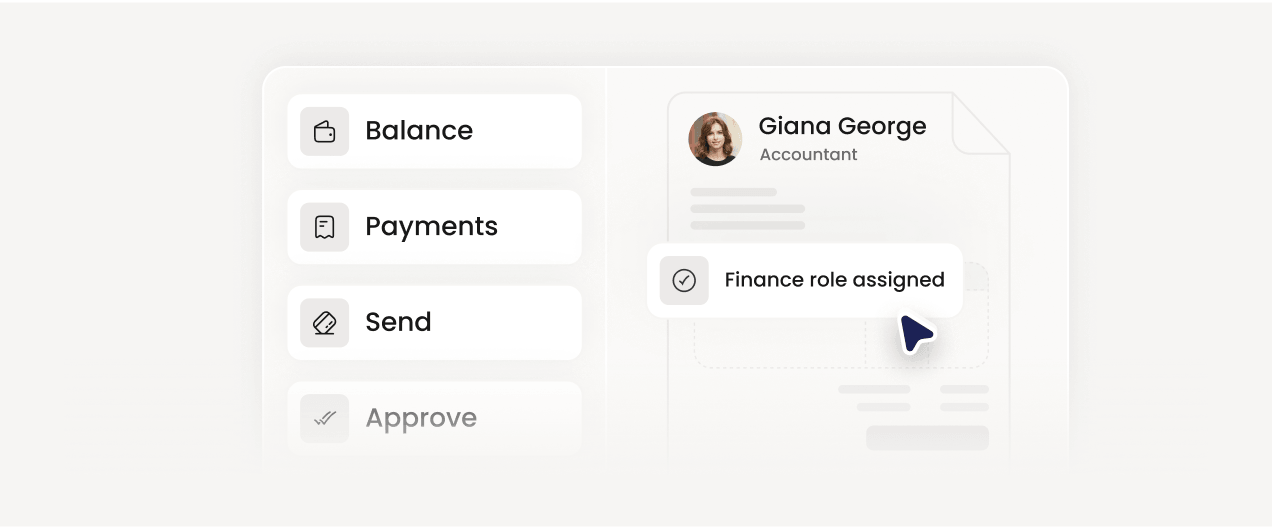
Manage payments, balances, cards, approvals and roles in one place instead of relying on fragmented banking tools and spreadsheets.
Run your startup's finances from one account
Open a multi-currency account, control team spend and pay globally with infrastructure built for fast-moving startups.
Open your accountStartup finance guides
Practical answers to the money questions founders run into, from opening an account to managing runway.
Getting your books audit-ready for due diligence
What reviewers look for in due diligence, and the statements, exports and audit trail that make your numbers easy to defend.
 Zara Chechi
Managing multiple entities from one platform
Run a holding company and its subsidiaries from one login, with separate balances per entity and a single consolidated view of cash.
Zara Chechi
Delegating finance ops as you grow: roles, approvals and segregation of duties
When to stop touching every payment, and how to set roles, dual authorisation and maker-checker so the team moves money safely.
Zara Chechi
Hold USD, EUR and GBP and get paid by overseas clients like a local
Hold several currencies, get local details so overseas clients pay you like a local, and convert when it suits you.
Zara Chechi
Business cards with no credit history or personal guarantee
How a brand-new startup with no revenue or track record can get cards: pre-funded cards you load, with no personal guarantee.
Zara Chechi
Control team spend: limits, merchant locks and approvals
Per-person limits, merchant and category locks, a card per vendor, approvals for larger buys, and seeing who spent what in real time.
Zara Chechi
Mass payouts: paying your whole contractor base in one batch
Bulk payouts by file or API, mixed-currency batches, handling a single failed payment, and keeping a clean record.
Zara Chechi
How to pay global contractors without losing money to FX
USD or local currency, how to keep an agreed fee constant when rates move, and how to read FX markup against the mid-market rate.
Zara Chechi
Where to keep startup cash after a raise
Why founders spread cash across more than one provider, the operating-account mix, and splitting a raise without a reconciliation mess.
Zara Chechi
Spending controls and reporting for investor funds
Multi-user roles, approvals on large outflows, read-only access for accountants, and clean statements for board and investor updates.
Zara Chechi
How to track runway and burn rate from your account
What burn and runway mean, gross versus net burn, and how to watch your runway with real-time balances and spend categories.
Zara Chechi
Ring-fencing the raise: pots for payroll, tax and reserves
Separate the raise into pots for payroll, tax and a do-not-touch reserve, and split near-term cash from your longer-term runway.
Zara Chechi
Receiving your funding round without bounced or delayed wires
The exact details to give investors, why wires bounce on a name mismatch, and how long an incoming international wire takes to clear.
Zara Chechi
EMI vs bank account: what startup founders should know
What an EMI is, how it differs from a traditional bank, and what to check before choosing where to run company money.
Zara Chechi
Proving source of funds when your startup is pre-revenue
What counts as acceptable proof of source of funds before you have revenue, and what providers typically ask for.
Zara Chechi
US founders: EIN, SSN and ITIN — what you actually need
What EIN, SSN and ITIN each mean, whether an EIN alone is enough, and how foreign founders verify identity remotely.
Zara Chechi
Opening a business account before you're incorporated or earning
What's realistic before the company is fully registered or trading, and how to prepare when you need account details early.
Zara Chechi
How to open a business account as a non-resident founder
What gets checked, the documents to have ready, and how foreign founders avoid the usual onboarding rejections.
Zara Chechi