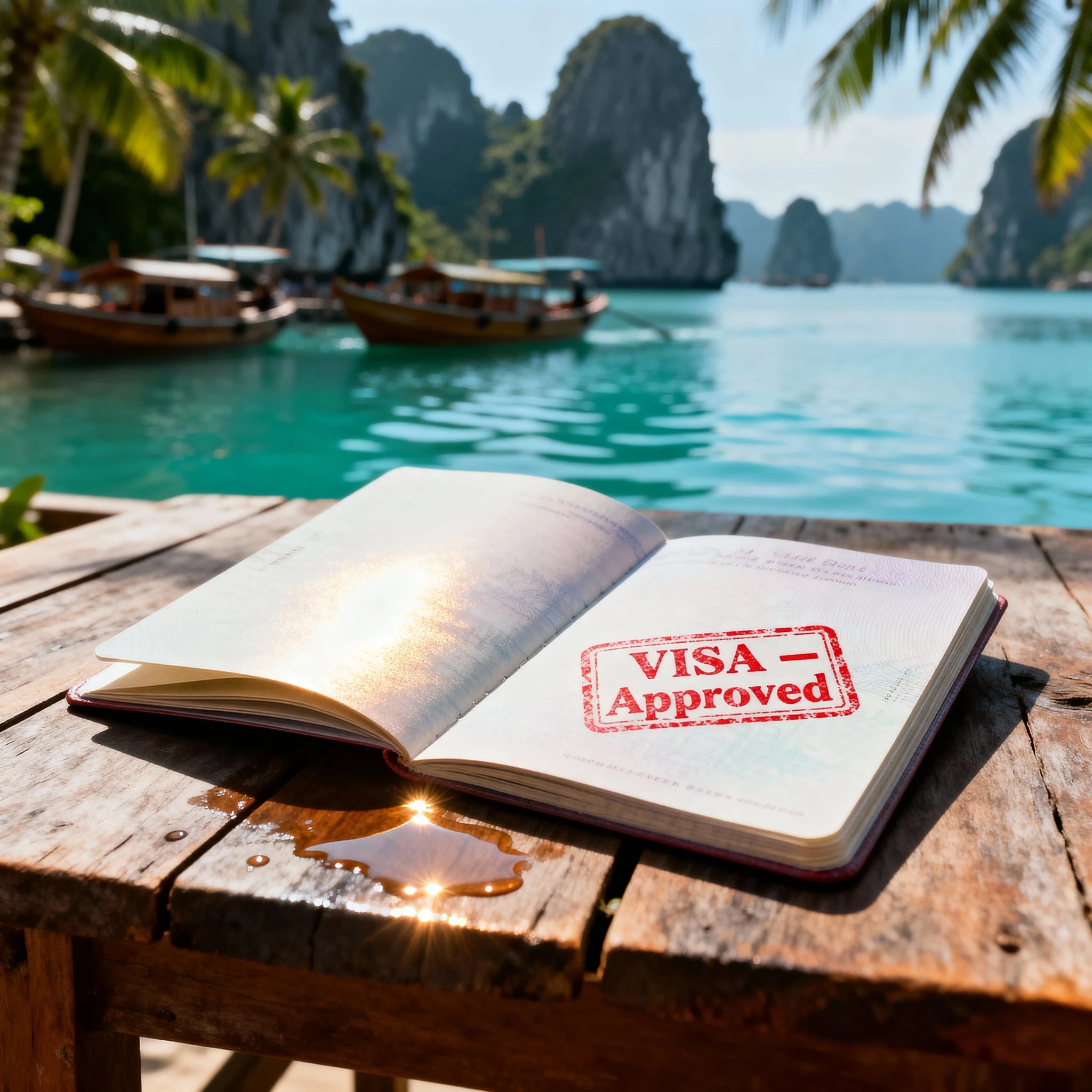
Dreaming of Vietnam as your next remote base? Vietnam is a favourite among digital nomads, but with no official digital nomad visa, navigating the legal landscape takes extra care. This guide helps high-earning remote professionals stay compliant while exploring long-stay options like the tourist e-visa or the more formal business visa.
We break down the key application steps, costs and common pitfalls, plus share expert advice on Vietnamese tax rules and how to stay legally secure while working from this dynamic and fast-growing destination.
The allure and the reality
Vietnam is a top choice for digital professionals drawn to Southeast Asia’s culture, affordability and connectivity. Cities like Ho Chi Minh, Hanoi and Da Nang offer strong infrastructure and a vibrant remote work lifestyle.
But unlike its neighbours, Vietnam doesn’t yet offer a dedicated digital nomad visa. Long-term stays require navigating existing visa options, mainly the short-term e-visa or more complex business visa routes.
This guide breaks down the key visa options, application steps, legal considerations and tax risk, helping you plan a compliant, long-term remote setup in Vietnam.
Visa types and legal alternatives
Vietname doesn't offer a dedicated digital nomad visa, so remote workers must rely on existing immigration pathways. It's important to understand that Vietnam only issues visas for tourism, study or formal employment. Working remotely for a foreign company while on a tourist visa falls into a legal grey area and may pose compliance risks.
The tourist E-Visa (DL)
This is the most common and accessible route for initial entry and short-term stay. The e-visa (electronic visa) can be obtained entirely online, removing the need to visit a Vietnamese embassy or consulate.
- Popularity: Favourited by remote professionals for its simplicity and speed.
- Current maximum stay: The duration has seen recent regulatory changes, but it currently offers up to 90 days (three months) of continuous stay for citizens of many key countries, including the UK, US, and Australia, for tourism purposes.
- The application: The vietnam tourist e-visa application requires minimal documentation.
- Visa extensions: Whilst previously a reliable option, the ability to secure a full visa extension without leaving the country has become increasingly challenging and less predictable since recent regulatory tightening. Those intending to stay longer than 90 days must plan for a departure.
Business visa alternatives (DN1/DN2)
For those seeking a stay exceeding 90 days, or those who wish to maintain a more formally compliant status, the business visa (typically DN1 or DN2 categories) is the primary alternative. This route is considerably more formal and complex than the tourist visa, as it requires a genuine connection to a Vietnamese entity.
- Sponsorship requirement: Obtaining a business visa mandates sponsorship. This means the applicant must have a local Vietnamese company, partner, or specialised visa agency (acting as a sponsor) willing to submit the necessary paperwork on their behalf.
- The approval process: The sponsor must apply to the Vietnamese Immigration Department to secure a pre-approval letter or visa approval letter before the applicant can formally submit their documentation or collect the physical visa stamp upon arrival (if required).
- Duration: Business visas are typically granted for three, six, or twelve months. Crucially, obtaining a 12-month business visa often requires establishing a highly credible connection or formal commitment.
Longer-term investor visas (DT)
For established entrepreneurs or those with significant capital who genuinely seek to establish a temporary residence permit (TRP) status, the Investor Visa (DT categories) offers the longest legitimate stay, often spanning one to five years. These routes require substantial, verifiable investment into a registered Vietnamese company and are reserved for those making serious, long-term financial commitments to the country.
The risk of the ‘visa run’
Because of the short validity and tricky renewal process of Vietnam's e-visa, many digital nomads resort to the 'visa run', briefly exiting to a nearby country (like Cambodia, Thailand or Laos) and returning with a new tourist visa. While common, this approach is tiring, unpredictable and brings legal and logistical risks. It's best treated as a temporary fix, not a lnog-term solution. For more stability, remote professionals should consider more secure visa routes, like formal business or investment visas.
Eligibility, requirements and the application process
Navigating the application process successfully requires precision. The requirements differ fundamentally between the simple e-visa and the complex business visa.
E-visa requirements and process
The e-visa process is designed for ease of access, making it the preferred entry method for casual long-term visitors.
- Documentation: The essential documents are straightforward: A valid passport (must be valid for at least six months from the date of planned entry). A recent digital passport photo (following size and background specifications). A digital scan of the passport data page.
Documentation: The essential documents are straightforward:
- A valid passport (must be valid for at least six months from the date of planned entry).
- A recent digital passport photo (following size and background specifications).
- A digital scan of the passport data page.
- Submission: The application is submitted via the official government portal by filling out the official vietnam visa application form.
- Payment: The standard e-visa fee is paid directly during the online submission process.
- Processing: The estimated processing time is typically 3–5 working days, although it is prudent to allow a full week, especially during peak travel periods. Once approved, the E-visa is printed and presented upon arrival.
Business visa requirements and complexity
The business visa process is bureaucratic and requires significant preparation and coordination with your Vietnamese sponsor or agent.
- Sponsorship/host entity: The primary hurdle is securing the sponsor (a registered Vietnamese legal organisation). Without a credible sponsor, this route is inaccessible.
- Pre-approval letter: The sponsor submits extensive documentation to the local Department of Labour and the Vietnamese Immigration Department. If approved, the letter is issued, permitting the applicant to proceed.
- Mandatory documentation: Requirements often include: Completed application forms specific to the DN category. Copies of the sponsoring company's operating licence and tax registration. Proof of the applicant’s business activities, qualifications, or investment intent (depending on the visa type). In some cases, a criminal record clearance certificate from the applicant’s home country.
Mandatory documentation: Requirements often include:
- Completed application forms specific to the DN category.
- Copies of the sponsoring company's operating licence and tax registration.
- Proof of the applicant’s business activities, qualifications, or investment intent (depending on the visa type).
- In some cases, a criminal record clearance certificate from the applicant’s home country.
- Proof of income/financial status: While not always mandatory for the initial visa stamp, some agencies handling the application on behalf of the sponsor may request proof of income or bank statements to demonstrate financial stability, particularly if the stay is intended to be for one year or more.
- Collection: The visa stamp is usually collected either at a Vietnamese embassy/consulate outside Vietnam or upon arrival at a major international airport. This process requires paying a separate visa stamping fee.
The entire procedure for a business visa is complex and variable, making the selection of a highly reputable visa agency or sponsor paramount to avoiding costly delays or rejection.
Costs, fees and financial planning
Financial transparency is key when planning a long stay in Vietnam. Unlike the clear pricing structure of a dedicated digital nomad programme, the costs in Vietnam are fragmented across government fees and agent service charges.
Standard visa fees and hidden costs
Fee type
Description
Estimated cost (USD Equivalent)
E-visa fee (Government)
Standard 90-day online application fee.
$25 – $50
Visa stamping fee
Required upon arrival or collection for non-e-visa types (e.g., Business Visas).
$25 – $150 (depending on duration/entries)
Business visa service fee
Fee paid to the local sponsor/agency for obtaining the pre-approval letter. This is the largest variable cost.
$300 – $1,200 (for 3 to 12 months)
Local Documentation Fees
Costs associated with notarisation, translation, and local governmental taxes by the sponsor.
Variable, usually factored into the Service Fee.
Visa run expenses
Flights/buses, accommodation, and the new visa fee in the destination country.
$150 – $350 per trip
Financial requirements and cost of living analysis
While the Vietnamese government does not impose a high minimum savings requirement for the E-visa, the cost efficiency of living here is arguably the country’s biggest draw for the high-earning digital nomad.
- Minimum financial security: Visa agencies facilitating complex business visas often require applicants to demonstrate sufficient, reliable income (sometimes citing figures between $2,000 and $3,500 USD per month) simply to prove viability and reduce the administrative risk of the application.
- Cost of living: Compared to major Western cities, the cost of living in Vietnam is dramatically lower. Housing options: A high-quality, modern apartment (serviced or unserviced) in prime districts of HCMC or Hanoi can be secured for $600 to $1,000 per month. This contrasts starkly with equivalent housing costs in Sydney or London, which can easily exceed $2,500 monthly. Operational costs: Food, transport, and utilities remain exceptionally affordable, leading to significantly higher disposable income and saving optimisation for the remote professional.
Cost of living: Compared to major Western cities, the cost of living in Vietnam is dramatically lower.
- Housing options: A high-quality, modern apartment (serviced or unserviced) in prime districts of HCMC or Hanoi can be secured for $600 to $1,000 per month. This contrasts starkly with equivalent housing costs in Sydney or London, which can easily exceed $2,500 monthly.
- Operational costs: Food, transport, and utilities remain exceptionally affordable, leading to significantly higher disposable income and saving optimisation for the remote professional.
Taxation and legal compliance
This section represents the most critical consideration for any professional planning a prolonged stay in Vietnam. Professional remote workers must treat vietnamese tax law and immigration statutes with absolute seriousness. Operating on a tourist visa while deriving income (even from a foreign source) constitutes illegal employment and carries severe risks.
The 183-day rule and tax residency
Vietnamese law determines tax residency based primarily on physical presence:
- Definition of residency: An individual is deemed a tax resident if they are physically present in Vietnam for 183 days or more within either a calendar year (January 1st to December 31st) or within 12 consecutive months from the date of arrival.
- Tax obligations: Once classified as a tax resident, that individual is legally liable for Personal Income Tax (PIT) on their worldwide income.
- Non-residents: Non-tax residents (staying under 183 days) are typically only taxed on income demonstrably sourced within Vietnam.
Taxation of remote work income
The legal situation for remote workers is complex. While foreign payroll may believe they are exempt, Vietnamese authorities have the statutory right to consider income derived from services rendered whilst physically in Vietnam as Vietnam-sourced income, regardless of the payer’s location.
- PIT Rates: Vietnam’s PIT uses a progressive tax scale, reaching up to 35% for high-level incomes.
- The risk of illegal work: The critical issue is the visa type. A tourist visa (DL) explicitly prohibits gainful employment. While prosecution is not universal, detection can result in immediate deportation, blacklisting from future entry, and substantial fines against both the individual and, potentially, the foreign company if information is shared.
Mandatory recommendation
Given the severity of the consequences associated with non-compliance, particularly for high-earning individuals who may have complex corporate structures, two actions are mandatory:
- Consult a tax professional: Upon planning a stay over 90 days, you must immediately engage a specialist tax professional knowledgeable in Vietnamese tax law and relevant international double taxation treaties. Do not rely on generalised advice; specific professional consultation is non-negotiable.
- Formal status: If the intent is to stay and work (even remotely) for periods exceeding the standard tourist maximum, the only compliant path is via a business visa (DN) or a formal work visa (LD), underpinned by a legitimate sponsor, thus formalising your status with the Vietnamese Immigration Department.
Life on the ground: Connectivity and communities
The logistical appeal of Vietnam to the digital nomad is immense. The advantages in infrastructure, lifestyle, and community often outweigh the bureaucratic complexities of the visa system.
Connectivity and infrastructure
Vietnam ranks highly for digital infrastructure, making remote work seamless.
- Internet reliability: Internet reliability is excellent across the major urban centres. Fibre optic connections are widely available and extremely affordable.
- Speed: Download speeds rival Western standards, and 4G/5G mobile coverage is robust, ensuring consistent access whether working from a café, co-working spaces or a private apartment.
Popular digital nomad cities
Vietnam’s appeal is diversified across three distinct hubs, each offering a unique lifestyle proposition:
- Ho Chi Minh City (HCMC): The commercial engine. HCMC is fast-paced, modern and boasts the largest and most developed network of expat communities and co-working facilities. It offers the most networking opportunities but comes with the most intense energy and traffic congestion.
- Hanoi: The cultural and political capital. Offering a more traditional Vietnamese experience, Hanoi appeals to those seeking history, deep culture, and a slightly cooler climate. The co-working spaces are sophisticated, particularly around Tay Ho (West Lake), which is the primary expat enclave.
- Da Nang/Hoi An: The coastal lifestyle choice. Da Nang provides modern urban amenities alongside spectacular beaches (like My Khe). Its proximity to the ancient town of Hoi An makes it highly attractive for those prioritising work-life balance and a slower, cleaner pace. Locations like My An and Son Tra house vibrant, supportive nomad communities focused on lifestyle and fitness.
Benefits and drawbacks summary
Advantages
Challenges
Exceptional affordability and low cost of living.
Complex and unpredictable visa renewal process.
High-speed, reliable internet and 4G/5G coverage.
Significant air quality issues in major cities (Hanoi/HCMC).
Strategic regional location for travel.
High-intensity traffic and urban noise.
World-class cuisine and vibrant cultural scene.
Legal ambiguity around remote work on tourist visas.
Bringing family and global comparisons
For established professionals, the ability to bring dependants is a significant factor. Furthermore, Vietnam’s complex system must be benchmarked against regional competitors offering dedicated nomad visas.
Dependents and family
Bringing dependants requires navigating additional bureaucratic hurdles.
- The challenge: Unlike employment visas (LD) or formal investment visas (DT), which offer a clear path for dependent visas (TT), obtaining dependent status via the standard business visa alternatives is difficult.
- Common practice: Families often rely on each member securing their own individual tourist e-visa or business visa (with the primary applicant's business sponsor facilitating the entire family). This requires meticulous coordination of visa expiry dates and managing simultaneous renewal processes or visa runs.
- Education and healthcare: Major cities offer excellent international schools and private healthcare facilities, although the associated costs must be factored into the overall financial plan.
Comparison benchmarking
The primary constraint of the Vietnamese system becomes clear when compared to regional and global peers who have invested heavily in structured remote work programmes.
- Structured programmes: Vietnam contrasts sharply with schemes like the thailand digital nomad visa (DTV) (formally the Long-Term Resident visa, or LTR) or the malaysia digital nomad visa (DE Rantau programme). These structured systems offer multi-year certainty, clearer tax guidance, and streamlined dependent visa routes, provided the applicant meets relatively high minimum income thresholds.
- The trade-off: While Vietnam lacks the security of the LTR or DE Rantau, its overwhelming advantage lies in its accessibility and the affordability of the cost of living. Many structured DN programmes require verified monthly income well over $3,500 USD, whereas Vietnam remains accessible to highly productive individuals who prioritise maximizing savings and lowering operational overheads.
- Bureaucracy vs. cost: Remote workers must weigh the higher administrative cost and bureaucratic friction of the Vietnamese system against the lower financial barrier to entry and dramatically reduced daily living expenses.
FAQs
Vietnam remains an undeniably compelling destination for high-earning digital nomads and remote entrepreneurs. Its economic buoyancy, cultural depth and robust infrastructure provide a world-class environment for work and life. However, success hinges entirely upon approaching the immigration process with due diligence, respect for the law and a willingness to commit to the correct, formal visa route if a stay is planned beyond 90 days. Professional compliance is not optional; it is essential to the longevity of your stay.
Frequently asked questions
Legally, no. The tourist e-visa (DL category) is explicitly issued for tourism purposes and prohibits engaging in any form of "gainful employment" whilst in Vietnam. Undertaking remote work places the professional in a regulatory grey area. If discovered by the Vietnamese Immigration Department, this can result in immediate deportation, substantial fines, and blacklisting from future entry, regardless of whether the income is sourced from a foreign entity.
The most sustainable and formally compliant long-term visa option is the Business Visa (DN category). Since the standard e-visa is limited to 90 days with unpredictable renewal processes, stays exceeding three months require securing a local sponsor (either a registered Vietnamese company or a professional visa agency). This sponsor must apply to the Vietnamese Immigration Department on your behalf to obtain a pre-approval letter, which is mandatory before you can receive the formal business visa stamp (typically valid for six or twelve months).
An individual is legally classified as a tax resident in Vietnam if they are physically present in the country for 183 days or more within a calendar year or a rolling 12-month period. Once tax residency is established, the individual becomes legally liable for Personal Income Tax (PIT) on their worldwide income, not just income demonstrably sourced within Vietnam. It is crucial to consult a specialist tax professional immediately if planning to approach this 183-day threshold.
The official processing time for the standard 90-day electronic visa (e-visa) is typically 3 to 5 working days, though applicants are advised to allow a full week for safety. The standard e-visa fee charged by the government for this service is generally between $25 and $50 USD. Note that this fee does not cover any subsequent visa runs or agent fees for complex business visa applications.
Vietnam offers a dramatic financial advantage. While bureaucratic friction exists in the visa renewal process, the cost of living provides significant optimisation opportunities for high earners. For example, high-quality, serviced apartments in prime districts of Ho Chi Minh City or Hanoi are typically available for 600 – 600– 1,000 USD per month, which is a fraction of the comparable housing costs in cities supporting the Thailand digital nomad visa (DTV) or major Western metropolitan areas.
This guide is provided for general informational purposes only and does not constitute legal, tax, financial, or other professional advice from ALTERY LTD or its affiliates. It should not be used as a substitute for advice from qualified professionals.
Altery makes no representations, warranties, or guarantees, whether express or implied, that the information in this guide is accurate, complete, or up to date.